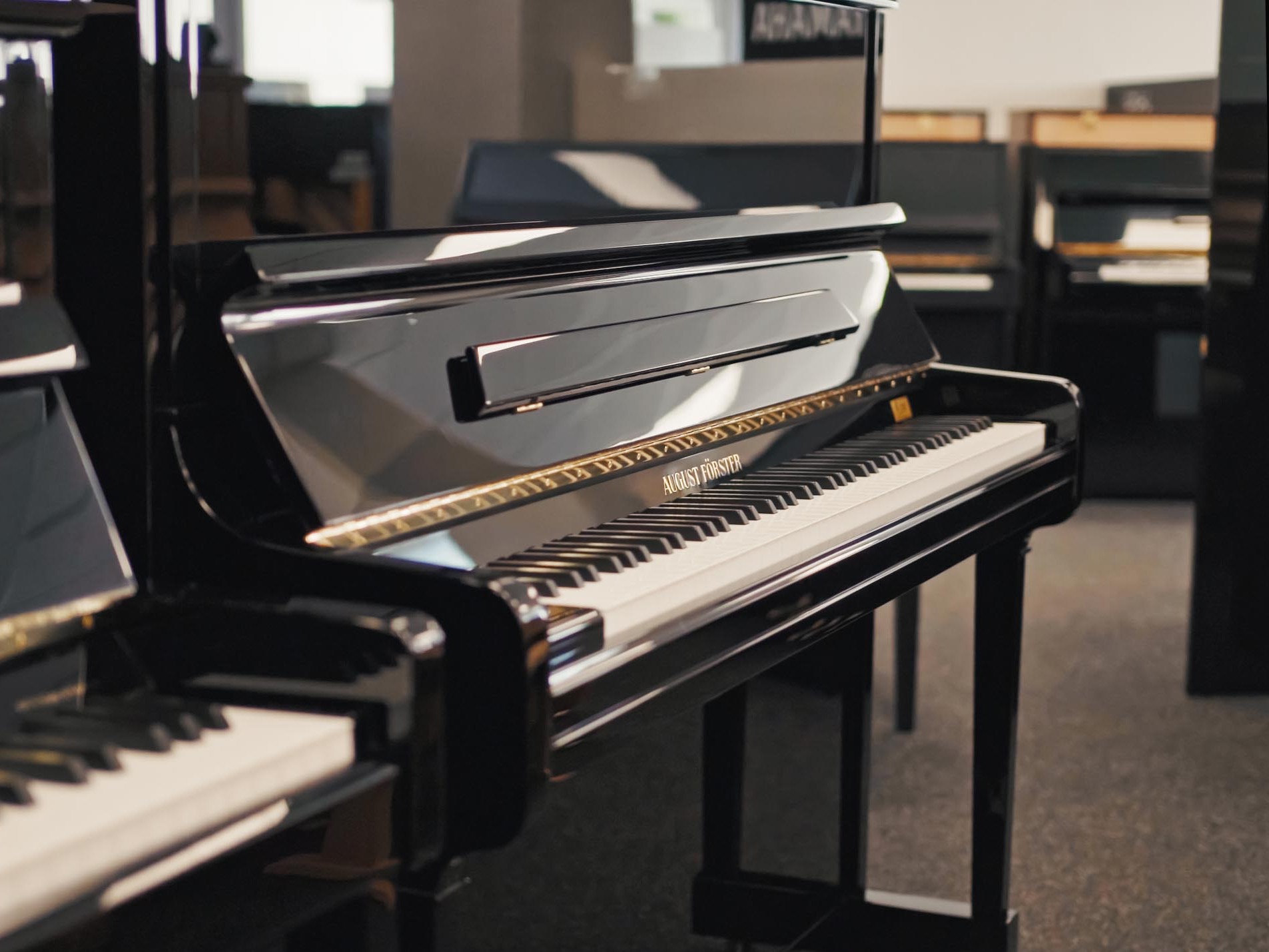
Choosing an upright piano can be difficult. Whether you are a beginner or an advanced pianist, this guide will help you make the right choice when buying or renting your instrument, taking into account your needs, budget, and available space. In addition, feel free to read our guide to grand pianos.
Introduction
The upright piano is a stringed instrument struck by hammers activated from a keyboard of 88 keys. The strings, made of steel for the middle and high registers and copper-wound for the low register, vibrate when struck. This vibration is transmitted by the bridge to the soundboard, which amplifies the sound and gives it its richness and depth. The quality of the sound and touch depends directly on the materials used and the precision of the manufacturing process.
How it works
- Vertical action: Unlike a grand piano, the action of an upright piano is vertical. Each key activates a hammer that strikes the strings, then a damper stops the vibration as soon as the key is released. This action allows for great expressiveness, but also rapid repetition of notes.
- Soundboard and frame: The cast iron frame and spruce soundboard are designed to withstand the tension of the strings and amplify the sound. The larger the soundboard and the more robust the frame, the better the resonance. An upright piano can withstand between 15 and 20 tons of tension on its cast iron frame.
- Pedals: Upright pianos are always equipped with at least two pedals: on the right, the sustain pedal, which prolongs the resonance of the notes by lifting all the dampers, and on the left, the soft pedal, which softens the sound and reduces the dynamics by moving the hammers. Upright pianos usually have a middle pedal, most often a mute that reduces the sound level by placing a strip of felt in front of the strings.
Advantages of an upright piano
1. Acoustic expressiveness
- Rich sound: An acoustic upright piano offers natural resonance, a wide sound palette, and unique expressiveness that is difficult to reproduce digitally.
- Sensitive touch: The mechanics of an acoustic piano allow for subtle nuances in playing. The weight and precision of the touch vary depending on the brand and model, offering a tactile experience tailored to each pianist.
2. A durable and evolving instrument
- Longevity: A quality upright piano can last for decades, even generations, provided it is well maintained.
- Sound identity: Each brand offers pianos with a distinct tone. Yamahafor example, is known for its clarity and balance, ideal for versatile playing. Petroffocuses on a warmer, more enveloping sound. Sauter offers instruments with great precision and a clear, brilliant tone. Finally August Förster, Steingraeber et Bösendorfer are characterized by a deep sound and great harmonic richness, with a dynamic range capable of filling a concert hall or an intimate living room.
- Design: Available in a variety of woods (mahogany, walnut, cherry, beech, etc.) and finishes (black, white, modern, classic), upright pianos fit perfectly into your interior.
Height, a key criterion
The size of a piano directly affects its power and tone. A grand piano offers better natural projection thanks to its large soundboard. Its longer strings produce a rich, deep tone, especially in the lower register. The piano’s size should also be appropriate for the size of the venue where it will be played.
- Student piano (107–115 cm) : Light sound, ideal for beginners or small spaces. Balance between size and sound quality.
Flagship models: Yamaha B10, Yamaha b2, Sauter Carus 112 (gamme supérieure)
- Standard upright piano (116–122 cm): Richer resonance, precise touch, versatile use.
Flagship models:Petrof P118 S1, Yamaha U1, Yamaha YUS1, Sauter Cosmo 116, August Förster 116E
- Grand upright piano (123+ cm): Better sound projection and more depth in the bass
Flagship models: Petrof P125 F1, Yamaha U3, Yamaha YUS3, August Förster 125G, Sauter Competence 130
- Prestige upright piano: Close to grand pianos in terms of sound power, very high-end
Flagship models: Bösendorfer 120, Bösendorfer 130, August Förster 134K
Tip: It is better to have a small, high-quality piano than a large, low-end piano.
Choose according to your level
- Beginners: A student piano is sufficient for learning and regular practice. Yamaha offers reliable and affordable models. Choose Petrof if you prefer a warm sound and don't plan on changing pianos for a long time.
- Intermediate/enthusiasts: Opt for an upright piano. Petrof, Sauter, and August Förster are excellent choices.
- Advanced/Professionals: A large upright piano (123 cm and above) or a high-end model such as Steingraeber or Bösendorfer is recommended.
Budget: New or used?
- New upright piano: Expect to pay from 4,000 CHF for an entry-level model. Prices rise to 30,000 CHF and above for high-end European brands.
- Used upright piano: Prices range from 1,500 CHF to 15,000 CHF depending on the brand, age, and condition. A well-maintained used piano can offer excellent value for money.
Silent: Play without disturbing others
Silent systems, such asadsilent or Yamaha's SC3/SH3 allow you to play with headphones without compromising sound quality. Yamaha's TransAcousticmeanwhile, offers a unique experience by combining acoustic sound with built-in digital amplification. On compatible pianos, we offer the installation of adsilent 2 systems, a discreet and effective solution for transforming your acoustic piano into a silent instrument. Ideal for apartments, studios, or nighttime practice, this service is performed by our qualified technicians for seamless integration and optimal sound quality.
Piano maintenance
- Annual tuning: To keep your piano in tune, we recommend tuning it at least once or twice a year, ideally in the spring and fall. Avoid periods of sudden changes in temperature or humidity. Additional tuning may be necessary in case of intensive use, exposure to very dry (winter) or humid (summer) air, or after moving. If you need your piano tuned, book now on this page.
- To preserve your piano, maintain a temperature between 64°F and 75°F and a relative humidity between 40% and 60%. Avoid sudden changes and monitor these conditions with a hygrometer if necessary. We offer humidifiers humidifiers in case the air is too dry.
- Gentle cleaning: Use an antistatic duster for dust, then a clean microfiber cloth for fingerprints. For glossy pianos, simply use our Cory Polish for effective cleaning.
- Moving: An upright piano weighs between 396 lbs and 771 lbs. To avoid damage, we advise against moving it yourself. For any transport requests, whether for a move or a transfer between floors, you can easily order transport fromthis page.
Additional accessories
A high-quality bench will serve you well for many years. We recommend the CGM 125, an Italian bench that is height-adjustable, made of wood with a solid structure, and available in a variety of finishes.
A piano lamp also allows for comfortable reading of sheet music. Explore our selection.
Try before you buy
Choosing an upright piano is an investment in an instrument that will be with you for years to come. Take the time to compare models, listen to their sound, and feel their touch. Each piano has its own personality. We are always delighted to welcome you to our stores to show you our models and help you make the right choice.